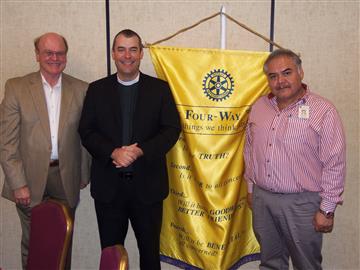
Professional Ethics: A Core Value of Rotary International
Austin NxNE Rotary Club considered Professional Ethics with a round-table discussion at our October 16, 2013 meeting. Joaquin Gloria III, Principal of Ridgetop Elementary School described the efforts of his school as it developed into a magnet school combining families of disparate languages, cultures and socio-economics. The Rev. Morgan Allen, Rector of The Episcopal Church of the Good Shepherd, related the anguish of dealing with inappropriate and dangerous behavior of a mentally challenged neighbor while maintaining an open and welcoming campus and congregation. Dan Taylor, Business Consultant with NextLevelPerformance, defined professional ethics and then acknowledged that in all his years of dealing with big business, he never knew of a business that taught professional ethics. Then each of these men led a round table discussion focused on his specific profession. Notes from each of the tables follow:
Professional Ethics in Education:
General Consensus: Teaching Ethics
*Ethical behavior used to be set by a community standard; now must look globally.
*Ethical behavior must be taught from the very beginning of a child’s life
*Ethics used to be taught at home—but definition of home has changed dramatically
and now must rely on the school; Ridgetop begins with 4-year olds
*Compromise is the solution to resolving differences
*Yet many see compromise as weakness
*Politicians are unwilling to see the other side of an issue; become entrenched
*Compromise is the very core of the lessons they teach at Ridgetop in a very clearly
defined program of Character Education
*Knowing each other can eliminate misunderstandings and resultant conflict
*Mr. Gloria knows every child and every parent
*When a child is sent to the Principal’s Office, Mr. Gloria and child have a
discussion, then child must call his/her parents
*Sometimes parents have difficulty in the follow-through that helps child understand
and deal with the consequences of his/her behavior
*Question: Are expectations the same in schools as 20 years ago? Yes, but not the same
in every school system.
Professional Ethics in Organized Religion
*Situation: Congregation committed to open and welcoming campus and community as a Christian value and has tolerated inappropriate behavior of a mentally-challenged neighbor for four years
*Now escalating to dangerous behavior
*Speak to individual or family first? Chose family; tried to engage them for support
in meeting needs of the individual and attempting to monitor individual
*Family non-communicative, no help received
*Now, ban family and individual from the church?
*Painful, but necessary, solution; we do the best we can with information we have,
hoping to leave the door open for further conversation
*Situation: Member reported similar situation with an elderly patient showing signs of
Alzheimer symptoms. Engaged the family with positive results.
*Situation: Helping persons of uncommon backgrounds build a relationship; e.g., marriage counseling or ecumenical work with groups of differing theologies and agendas.
*Ignore the differences (for time being at least)
*Define the common goal, create a common value system to achieve that goal
*Situations unique to the Church:
*Professional confidences and the inability to air all the facts, can lead to pastor
taking criticism and abuse from those who do not know or understand all the facts
*Question: Why is there so much selfish behavior at all levels of society?
*Answer: Fear. Fear of not having enough to meet own needs or not being able to
provide for family, fear of others (who are not known or understood), fear of future
*Question: Who is entering ministry now? Is the younger generation ready?
*Answer: Morgan’s experience is that the young he meets on that path are those
Passionate about wanting to make a difference in the world and have high ethical
standards; the young 20’s-something are more mature and sophisticated than previous
generations.
*Question: Discuss ethics in stewardship. Ran out of time but two quick comments:
*If a person is not obviously committed to the church, then we don’t ask for money
*We don’t accept money with strings attached
Professional Ethics in the Business
*General Consensus: Value of Professional Ethics
*Ethics have a powerful influence on business success and continued existence
*Ethics are essential for strong business-customer relationships
*Ethics can create a positive image which results in customer trust, business growth
*Conversely, wrong ethics can create a negative image which results in loss of
customer trust and loss of business; e.g., Enron
*Ethics are based on honesty in everything, understanding [based on facts] of the
situation and following the laws of man; twisting laws of man may mean losing
the laws of God
*General Consensus: Teaching Ethics
*Need for higher ethical standard in all of society
*Ethics are basic to all of life: taught in family, the same in all areas: never try to
take advantage of another person
*Difficult to pass down ethical standard in family when both parents/single parents
work long hours; therefore, significant need for other options now
*All of community responsible for modeling high ethical behaviors
*School becoming more important in this instruction/modeling; school and home
must be partners working together
*Ethics learned the hard way: misunderstanding with parents, leave home for
military, learned much about human values and interactions. Bottom line: treat
others as you want to be treated
*Situation: A law firm client made over-payment on a loan.
*Error explained, extra money returned.
*Law firm maintained high ethical standard, plus such behavior often means the
client returns, bringing further business.
Situation: CPA reported that ethics classes are required by law
Leader Dan Taylor provided a facilitation model for discussing and resolving ethical
problems
All tables reported lively and focused participation in a broad arena of backgrounds, questions, and suggestions. Members offered words of appreciation for the theme and the opportunity this format presented. Today we were inspired by not only a “Rotary Minute,” but a “Rotary Hour!” We alone, among all the service organizations, have an at-the-ready ethical component: The 4-Way Test. It is our responsibility and duty not only to use it in “all the things we think, say, or do,” but to share, teach, and model it to all whom we touch.