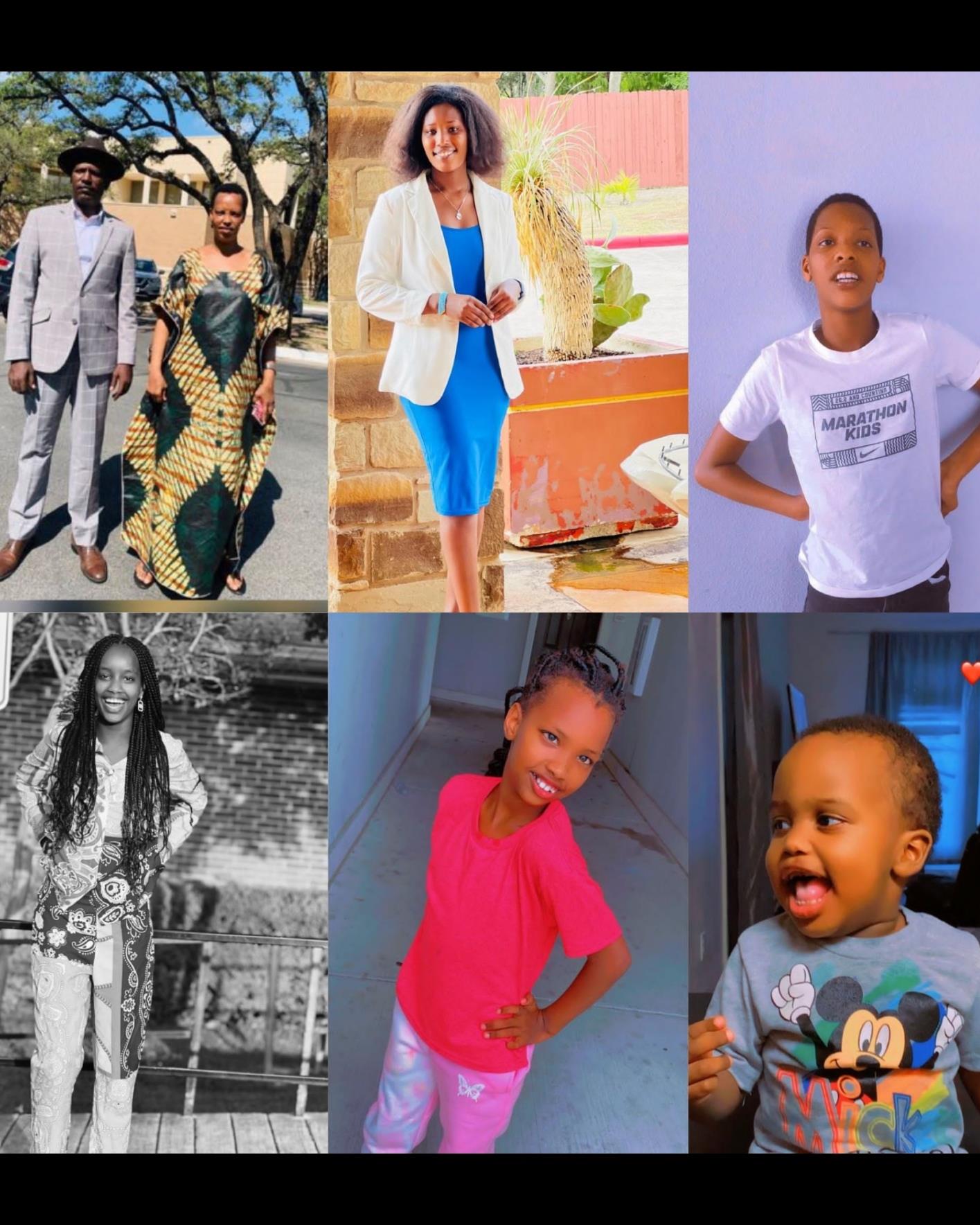
Mukire Family
The Mukire’s story is one of war, violence, fear, and ethnic conflict starting in the Democratic Republic of the Congo, spanning 15 years of life in refugee camps in Burundi, and ultimately ending with resettlement in Austin in 2019. In 2004, Aimable Mukire was caring for his young family, two children and a wife, Chantal, while also attending University in the Democratic Republic of the Congo. One day in early 2004, while Aimable was at school and his family was at home, soldiers began attacking. To avoid violence and execution, Aimable had to immediately flee, as did his wife and children. But because they were not together when the violence began, they were separated as they fled and struggled to find each other on their journeys toward the Gutumba refugee camp in Burundi. While trying to reach the border Aimable was shot above the knee, making his already difficult journey exponentially more difficult. He was forced to surreptitiously travel, all while avoiding marauding soldiers, searching for his lost family, and trying to heal from a wound that would ultimately leave him in chronic pain. Similarly, Chantal, with a 3 year old and a newborn baby in tow, had to make her way to the Burundi border while avoiding violence and searching for her husband. Like Aimable, she was not spared violent encounters, at one point being injured by a soldier with a machete before escaping with her life. Eventually, Aimable found his way to the Gutumba camp in Burundi, where his wife and children had also fled. The family’s search for each other was at an end, but their encounters with rampant violence and genocide was not. In August, 2004, the Gutumba refugee camp was the site of a heinous civilian massacre. Miraculously, Aimable and his family made it through the attack alive and physically unhurt. However, they, along with the other survivors, were now faced with a long journey over hundreds of miles of Burundian territory to another refugee camp on the Tanzanian border. Once the Mukires found themselves at the Kinama refugee camp in Burundi, they were left to wait for resettlement. This wait lasted from 2004 to 2019, when they were resettled in Austin. While at the Kinama camp, the Mukires had two more children, so when they came to the US, it was with 4 children total. Now they also have a baby who was born here in Austin. Two of their kids have developmental disabilities. Having lived in refugee camps all their lives forced them to deal with those special needs as they could without the advice or help of professionals.
What sets this family and their needs apart from others?
Being a refugee and experiencing devastating displacement and violence in and of itself results in a family having extraordinary needs. However, the Mukire family has additional burdens on top of those of the typical refugee family. Two of their daughters, Valerie and Mediatrice, have developmental disabilities. They are unable to speak, and can walk very unsteadily and tend to fall. Their physical growth seems stunted. As a result, Aimable is their full-time caretaker. To do anything, from eating breakfast in the morning to going to bed at night, the girls need help. Though they are in school part of the day, the new baby needs care as well. In addition to regular childcare needs, the Mukire needs help navigating Medicaid services and helping them set up therapies and care times for the girls. Taking care of his kids, combined with injuries from a car crash that exacerbated his already existing knee injury, has prevented Aimable from being able to work. Currently his wife, Chantal, is the sole provider for the family, working for Applied Materials as a cleaner. The family is extremely grateful to be in the US and Austin. They are so happy their children can play with other children and go to school without fear. However, they do not feel completely secure. They no longer have a car (also a result of the car crash in January) and have only one income to support a family of seven; a family which includes two disabled children and a newborn baby.